
The Indian central government has reduced its total expenditure by approximately 60,000 crore in FY26, below its revised estimate, to successfully achieve the fiscal deficit target of 4.4 per cent of gross domestic product (GDP), according to the latest data from the Controller General of Accounts (CGA).

Finance Minister Nirmala Sitharaman announced a fiscal deficit target of 4.3% of GDP for FY27, continuing the path of fiscal consolidation. The government aims to reduce the debt-to-GDP ratio to 55.6% by BE 2026-27 and further to around 50% by March 2031.
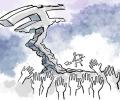
India's fiscal deficit is projected to reach 4.5 per cent of GDP for the current fiscal year, exceeding the budgeted target, as the government's policy responses to the West Asia conflict are expected to strain public finances, according to research firm BMI.
Eighteen of India's 28 states exceeded the fiscal deficit ceiling of 3 per cent of GSDP in FY25, a deterioration comparable to the Covid year of 2020-21, according to the Comptroller and Auditor General (CAG). The report also noted a decline in states reporting a revenue surplus, with Bihar, Mizoram, and Telangana moving into deficit.

Using the debt-to-GDP ratio as a fiscal anchor aligns with efforts to promote fiscal transparency through proper disclosure of off-budget borrowings.

The Centre's fiscal deficit stood at 17.9 per cent of the full-year target at the end of June, according to data released by the Controller General of Accounts (CGA) on Thursday. It was at 8.4 per cent of Budget Estimates (BE) of 2024-25 in the first three months of the previous financial year.
The Centre's fiscal deficit at the end of the eighth month of financial year 2024-25 touched 52.5 per cent of the full-year target, government data showed on Tuesday. In absolute terms, the fiscal deficit -- the gap between the government's expenditure and revenue -- was about Rs 8.47 lakh crore during the April-November period, according to the data released by the Controller General of Accounts (CGA).
The Centre's fiscal deficit at the end of the first seven months of financial year 2024-25 touched 46.5 per cent of the full-year target, government data showed on Friday. In absolute terms, the fiscal deficit -- the gap between government's expenditure and revenue -- was at Rs 7,50,824 crore during April-October period, according to data released by the Controller General of Accounts (CGA). The deficit stood at 45 per cent of the Budget Estimates (BE) in the corresponding period of 2023-24.
India Ratings & Research (Ind-Ra) has projected the aggregate fiscal deficit of states to rise to 3 per cent of gross domestic product (GDP) in 2026-27 (FY27), from an estimated 2.8 per cent in 2025-26 (FY26), citing higher revenue expenditure amid election-related pressures and scheme cost-sharing requirements.

The Centre's fiscal deficit at the end of the first five months of the current fiscal touched 27 per cent of the full-year target, government data showed on Monday. In absolute terms, the fiscal deficit -- the gap between expenditure and revenue -- was at Rs 4,35,176 crore as of August-end, according to data released by the Controller General of Accounts (CGA). The deficit stood at 36 per cent of the Budget Estimates (BE) in the corresponding period of 2023-24.

The Centre's fiscal deficit touched 74.5 per cent of the annual target at the end of January 2025, according to the data released by Controller General of Accounts (CGA) on Friday.

The central government's fiscal deficit fell to 0.8 per cent of the full-year target at the end of May, mainly due to a whopping Rs 2.69 lakh crore dividend received from the Reserve Bank of India. The fiscal deficit, or gap between the government's expenditure and revenue, had touched 11.9 per cent of the Budget Estimates (BE) for 2025-26 or Rs 1.86 lakh crore in April.

'We have to retain some fiscal headroom without compromising on the promised fiscal consolidation roadmap.'

The Budget should undertake further reductions in import tariffs and seriously consider an announcement of India's intention to join one or both of the two Asian mega-regional free trade agreements, suggests Shankar Acharya, former chief economic adviser to the Government of India.
Union Finance Minister Nirmala Sitharaman on Tuesday said the fiscal deficit for 2024-25 is estimated at 4.9 per cent of GDP.
In November, the fiscal deficit widened by Rs 2.2 trillion, the highest ever in any month this financial year.

The forthcoming Budget could think of maintaining public capital expenditure at 3 per cent so that domestic resources are available for private investments, points out N R Bhanumurthy.

If we don't take the fiscal deficit seriously, then it could easily widen and harm our future growth

Indian states significantly increased their reliance on market borrowings to finance gross fiscal deficits in 2025-26, with the share of market borrowings rising to 76.3 per cent, even as the weighted average cut-off yield on State Government Securities (SGS) and spreads over central government securities also increased.

'Any finality in such matters requires political views. We will review it closer to the full Budget.'

A new white paper released by the Tamilaga Vettri Kazhagam (TVK) government reveals that Tamil Nadu's direct debt has nearly doubled to an alarming 10 trillion in the past five years, exposing significant fiscal strain and a substantial debt burden on every citizen.

Continuing on the fiscally prudent path, the Modi government in the interim Budget refrained from announcing populist measures, which will help it trim the fiscal deficit to 5.1 per cent of the GDP next fiscal and 4.5 per cent in FY26.

Advance estimates on Tuesday estimated nominal GDP this financial year to be slightly less than that projected in the Budget, and this would magnify fiscal deficit as a portion of GDP.

India's exports reached a six-month high, growing by 18 per cent to USD 45.2 billion in May, driven by electronic goods, petroleum products, engineering items, and pharmaceuticals. However, the trade deficit widened to USD 28.21 billion due to a 10 per cent rise in imports, particularly petroleum products and gold, amidst surging crude oil prices.

The central government's fiscal deficit during 2023-24 at 5.6 per cent of the GDP was better than previous estimates of 5.8 per cent on account of higher revenue realisation and lower expenditure, according to official data released on Friday. In actual terms, the fiscal deficit -- or gap between expenditure and revenue -- was Rs 16.53 lakh crore, or 5.63 per cent of the GDP, which grew 8.2 per cent in 2023-24.

At a meeting of the Institute of International Finance, a global association of financial institutions, Standard Chartered Bank Chief Economist, Gerard Lyons, raised doubts over the Centre's projections of reducing fiscal deficit from 2010-11's estimate of 5.1 per cent. "I am skeptical whether fiscal deficit can be reduced as planned," he said.

Elevated global crude oil and natural gas prices, driven by geopolitical developments in West Asia, could significantly influence the Government of India's fiscal position for 2026-27, according to a report by ratings agency Icra.
Admitting that fiscal deficit was a "major source of worry", Finance Minister Jaswant Singh on Thursday said pegging it at 5.6 per cent of GDP for the coming year was not "unsatisfactory" given the adverse circumstances.

India's fiscal deficit trends are a bit like an alcoholic trying, unsuccessfully, to reform. Virtue does not last for too long, says Shankar Acharya.
Expressing serious concern about the country's financial health, Prime Minister Manmohan Singh on Thursday warned that economic progress could be hindered if the mounting fiscal deficit of 9 to 10 per cent of the national income was not contained.
If the fiscal deficit for the year can be maintained at Rs 7.04 trillion, the deficit as a percentage of GDP will slip to 3.44 per cent

The central government's fiscal deficit touched 67.8 per cent of the full-year target at the end of January due to higher expenses and lower revenue realisations, according to official data released on Tuesday. In actual terms, the fiscal deficit or gap between the expenditure and revenue collection during April-January period stood at Rs 11.9 lakh crore, as per the data from the Controller General of Accounts (CGA). The fiscal deficit in the comparable period of 2021-22 was 58.9 per cent of that year's Revised Estimate (RE) in the Budget.

To meet the revised estimates for 2019-20, the central government will have to garner Rs 5.03 trillion in total revenues in March, which has seen the worst phase of the coronavirus pandemic so far and the resultant lockdown.
Bank of Baroda economists project India's GDP to grow 6.5-6.8 per cent in FY27 but warn that the fiscal deficit could overshoot the budgeted 4.3 per cent target, potentially reaching 4.7-4.8 per cent of GDP due to subsidy overruns, excise duty cuts, and oil marketing company losses.

The government's capital expenditure in the April-November period of financial year 2024-25 (FY25) continued to contract with a 12.3 per cent decline year-on-year (Y-o-Y), according to data released by the Controller General of Accounts on Tuesday.

But the government will present a second tranche of Supplementary Demands for Grants during the Budget session of Parliament in February, when it can seek additional spending.
While presenting the Union Budget to Parliament earlier this month, Finance Minister Nirmalal Sitharaman had raised fiscal deficit target to 3.8 per cent of the GDP from 3.3 per cent pegged earlier for 2019-20 due to revenue shortage.
The Budget estimate for the fiscal deficit in the year 2009-10 is Rs 3,32,835 crore (Rs 3,328.35 billion). Last year 2008-09, the first two months of the fiscal had accounted for 54.9 per cent of the year's Budget estimate.

The government will have a tough time correcting its financial course from the current high level of fiscal deficit, unless it decides to raise taxes or cut spending, said Prime Minister's Economic Advisory Council (PMEAC) member Govinda Rao.
The central government's fiscal deficit touched 32.6 per cent of the annual target in the current financial year till August as against 31.1 per cent recorded a year ago, according to official data released on Friday. In actual terms, the fiscal deficit -- the difference between expenditure and revenue --- was Rs 5,41,601 crore during the April-August period of this financial year. Fiscal deficit is an indicator of the government's borrowings from the market.
